THE FAILURE / DIGITAL CONTROL, PHYSICAL LOSS
The attack reached the machinery that keeps food saleable.
Reuters reported on October 12 that attackers raised refrigeration temperatures at hundreds of French supermarkets, with some reaching 50°C (122°F). France’s Paris prosecutor’s office described a large-scale attack associated with food losses and fires. The incident affected multiple retailers, rather than a single isolated shop.
A supermarket can restore a computer from a backup. It cannot restore spoiled inventory that way. This is what makes an attack on refrigeration different from an unavailable website: the recovery clock is also a physical process.
01 / Fires were reported. The scope needs care.
The headline is alarming, but the distinction between the wider incident and individual retailers matters. Les Mousquetaires told CNBC that overheating produced smoke in some of its stores, but that no fires had been reported within that account. The group said approximately 180 stores were affected and anticipated losses of several million euros, with more precise damage assessments pending.
That does not erase the prosecutor’s broader report of fires. It means the two statements describe different scopes. The public sources reviewed here do not provide a verified store-by-store fire count or a technical finding about how each fire began.
The reported temperature should also not be mistaken for an ignition explanation. A temperature measurement, an altered setting, smoke, and a confirmed fire are different observations. Establishing the chain from malicious commands to equipment damage requires technical inspection and incident records.
CNBC also reported that Intermarché and Netto removed and disposed of affected products. That is a tangible consequence even where no fire occurred: lost stock, interrupted sales, cleanup, and staff time devoted to an emergency rather than normal operations.
02 / The vulnerable surface was the control system
France’s CERT-FR alert, updated October 16, identifies compromises involving Danfoss AK-SM and AK-SC controllers, plus Copeland and Dixell XWEB systems. It warns against exposing management interfaces directly to the internet. This is broader than a story about one brand of refrigerator.
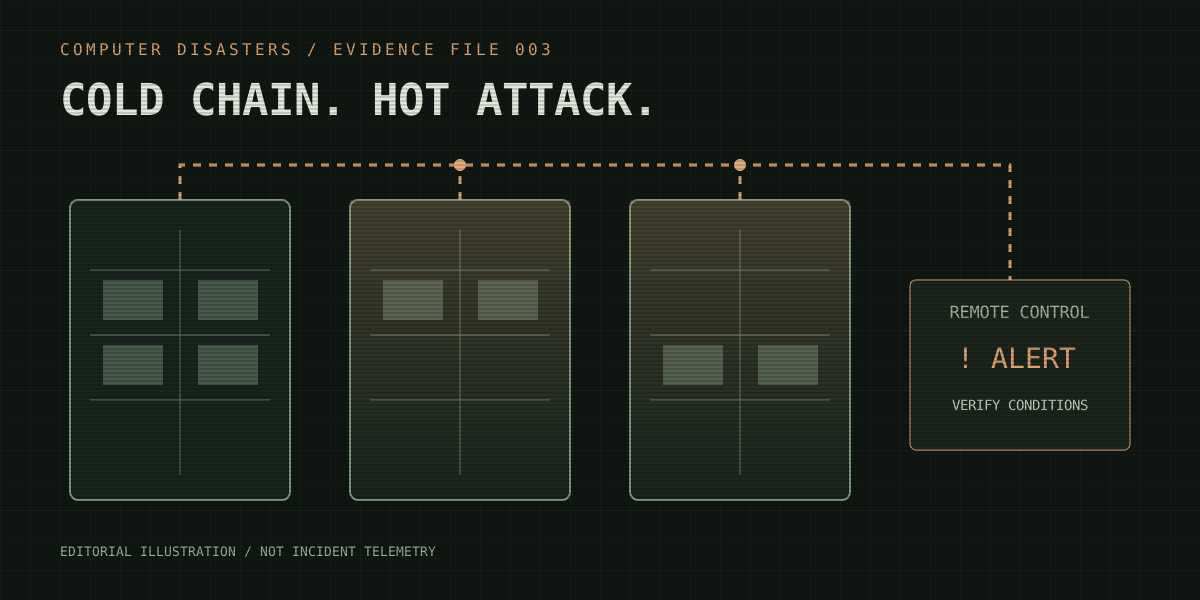
The useful mental picture is a control layer between a person and physical equipment. Legitimate remote access helps technicians maintain systems without visiting every location. The same authority, if obtained by an attacker, can turn an administrative change into an operational event.
Conceptual failure chain, not a confirmed reconstruction of the attacker’s entry path.
Danfoss told Reuters that affected French units were running outdated firmware. That statement is relevant to maintenance risk, but does not prove which vulnerability was used at each store. The reviewed advisory does not supply one universal exploit narrative for every affected product.
A claim that “the hackers used AI” would require its own evidence. So would attribution to a nation-state or a particular criminal group. Neither is established by the sources used for this article. The physical consequences are serious without adding an unverified motive or a fashionable attack technique.
03 / From disruption to updated guidance
| Date | Public record |
|---|---|
| October 12 | Reuters reports the refrigeration attack and retailer disruption. CERT-FR publishes its initial alert. |
| October 13 | CNBC reports the Les Mousquetaires statement distinguishing smoke from fires in its stores. CERT-FR expands its list of targeted equipment. |
| October 16 | CERT-FR revises its remediation recommendations and warns that exposed, unsupported equipment remains at high risk. |
| October 19 | This article reviews those reports and the updated advisory. The reviewed record is not a final forensic postmortem. |
Dates above follow the advisory’s revision history and the linked reporting. Publication dates do not establish the precise time an attacker first entered a system.
04 / A reset is not the same as a recovery
CERT-FR recommends removing public exposure, restoring access through a secure VPN or protected network, checking configurations including defrost schedules, and applying manufacturer security measures. Its warning is especially important for unsupported equipment: a factory reset alone leaves the system vulnerable if the original exposure remains.
That advice separates two jobs that are often confused. One is clearing an unwanted state. The other is closing the path that allowed it. A controller that returns to its normal display may still be reachable by the same attacker.
For a retailer, there is a third job: demonstrating that the physical operation is safe to resume. An incident team needs engineering, refrigeration, food-safety, store-management, and security expertise working from the same situation report. An IT recovery milestone should not automatically become permission to restock a cabinet.
Changes to refrigeration equipment should be coordinated with qualified operators and the manufacturer’s instructions. We are not providing a blanket instruction to disconnect, reboot, or reset live machinery. The right sequence must account for local conditions, monitoring continuity, and product disposition.
Three separate recovery decisions
- Access: Has unauthorized control been removed, and is the entry route closed?
- Operation: Have legitimate settings and equipment behavior been verified independently?
- Inventory: Has the responsible food-safety team decided which stock can remain and which must be removed?
These are editorial response questions, not a finding about what any named retailer did or failed to do.
05 / Build for the bad command, not just the broken connection
A familiar monitoring question is, “Is the controller online?” This incident suggests a harder one: “Is it doing something legitimate?” A reachable device can be working perfectly from the attacker’s perspective.
Our design recommendations follow from that distinction:
- Separate observation from authority. A system that reports conditions should not automatically grant the ability to change them. Review who needs each permission.
- Use independent checks. Consider whether a compromised controller could also undermine the team’s view of conditions. Independent measurements and escalation paths can reduce that dependence.
- Limit the reach of remote maintenance. Make it possible to isolate an affected location or service relationship without improvising a chain-wide shutdown.
- Treat old equipment as an active responsibility. Record its support status, owner, replacement plan, and permitted connectivity. “Still running” is not a security assessment.
- Rehearse overnight escalation. A credible drill starts when the usual experts are unavailable and asks who can verify conditions, authorize containment, and coordinate the stores.
These controls are not evidence of an identified missing safeguard at a particular supermarket. They are questions for any organization whose software can change a physical process.
The shared dependency can hide in plain sight
Retail brands may compete while relying on similar classes of controllers, maintenance arrangements, or remote-access practices. A fleet inventory should therefore include operational technology, not just laptops and servers. Otherwise, a business may discover a critical dependency only after multiple locations fail together.
Do not turn simultaneous news into attribution. Reuters reported that Ahold Delhaize saw no reason to connect its separate security incident with the French refrigeration attacks. A shared industry and nearby dates do not establish a shared attacker.
THE COMPUTER DISASTERS LESSON
You can restore the settings. You cannot unspoil the food.
The most consequential computer disasters are not always the ones that delete the most files. Sometimes the crucial boundary is between a remote command and a physical process that cannot simply be reversed.
Refrigeration belongs in the security plan because it belongs in the business’s survival plan. Protecting it means controlling access, verifying real conditions, and knowing who can act before a digital incident becomes a much larger operational loss.
Review the failure modes in your own system →Previous Field Note: OpenCode’s breach and the authority carried by an API key →
Sources & method
This is an original analysis of public reporting and an official security advisory, not an on-site investigation. French guidance is paraphrased in English. We did not inspect affected equipment, review private forensic records, or independently assess fire damage. Reported impacts are attributed; the design recommendations are our analysis.
- Reuters — Hackers heat French supermarket fridges, sparking fires and spoiling food · Published October 12, updated October 13, 2026. Reporting on the prosecutor’s statement, retailers, and Danfoss.
- CNBC — French supermarket fridges get hacked, heating to 122°F and sparking fires · October 13, 2026. Includes the retailer’s narrower statement about smoke, damage estimates, and product removal.
- CERT-FR — Security incident targeting remote refrigeration controllers · October 12–16, 2026. Official affected-system list, revision history, and remediation guidance.