THE RECORD / A SUSTAINED INFLUENCE CAMPAIGN
Russian pro-Trump influence operations are a documented part of this story.
The bipartisan Senate Intelligence Committee investigation found that the Internet Research Agency sought to help Donald Trump and damage Hillary Clinton under Kremlin direction. The 2021 intelligence assessment of the 2020 election identified another Russian effort to support Trump, undermine Biden, and intensify divisions. These findings should be stated plainly.
The question raised by the new video is more specific: did the Yandex outages disable the accounts producing the political activity it describes? The historical record makes that a legitimate subject to investigate. The traffic graph alone does not answer it.
01 / The record predates this video by years
Calling the entire issue an unproven “bot theory” would erase a substantial public record. Investigators have described personnel, budgets, fake identities, domains, account networks, and distribution methods. The evidence comes from different kinds of sources: congressional findings, intelligence assessments, criminal allegations, and independent threat research. They should be identified as such rather than flattened into a single claim.
2016 campaign → 2018 indictment: an organized operation
The February 2018 IRA indictment announcement described an organization with hundreds of staff and departments covering content, graphics, technology, and finance. Prosecutors alleged that operatives concealed their location through U.S. servers, adopted American identities, bought political advertising, and recruited unwitting Americans for political events. The alleged operation combined online impersonation with activity in the physical world.
This matters because “bot farm” can sound like a warehouse full of machines posting nonsense. The described system also relied on people: managers, writers, technicians, and organizers. An account could be operated by a human and still be part of a deceptive foreign campaign. The indictment is an allegation, not a conviction of every named defendant.
2019 Senate findings: the pro-Trump direction was explicit
The committee’s report release, issued under Republican chairman Richard Burr and Democratic vice chairman Mark Warner, described IRA election activity as overwhelmingly favorable to Trump and harmful to Clinton. It also identified efforts to inflame racial, immigration, and gun-rights tensions, with African Americans particularly targeted. Operatives engaged unwitting people and sought assistance with rallies and campaign materials.
Targeting several communities does not make the electoral aim neutral. A campaign can promote one candidate while provoking distrust or discouragement elsewhere. The committee also reported that IRA activity continued and increased after the election: the operation was broader than a single voting day.
2020 election → 2021 assessment: narratives routed through proxies
The declassified intelligence assessment judged with high confidence that Putin and the Russian state authorized and conducted operations intended to damage Biden and the Democratic Party, support Trump, and weaken confidence in elections. It described intermediaries linked to Russian intelligence pushing misleading or unsubstantiated narratives through American media, officials, and prominent individuals.
That is a different mechanism from an obvious automated reply account. A message can acquire apparent domestic credibility as it passes through intermediaries. Attribution to the original operator becomes harder when the version a reader encounters comes from a familiar voice.
2024: fake personas and counterfeit news infrastructure
Two distinct Justice Department actions illustrate the range. The July case, examined below, concerned an AI-assisted account network. In September, the Doppelganger disruption involved 32 domains. Prosecutors alleged that Russian-directed companies used sites impersonating news brands, fabricated personas, paid promotion, and influencers to distribute concealed propaganda. The stated goals included weakening support for Ukraine and influencing elections in the United States and other countries.
The associated affidavit included internal planning records. That kind of material can connect an observed distribution system to its intended purpose. A copied news logo is not merely a design choice in such an operation: it borrows the reputation of a real publisher to obscure who is speaking.
2024 independent reporting: fabricated videos aimed at Harris
Microsoft’s September 17 threat report described Russian actors Storm-1516 and Storm-1679 shifting toward the Harris-Walz campaign. It identified staged or fabricated videos intended to discredit Harris, including one routed through a newly created site posing as local news. Microsoft reported millions of views for two Storm-1516 videos.
Those observations provide a concrete example of anti-Democratic candidate messaging reaching an audience. View totals establish distribution, not how many viewers believed the content. They nevertheless show why investigating the production and circulation of these materials is consequential.
This is a selective chronology of public findings, not a claim that all the operations shared one command structure or one data center. The continuity is the use of concealed actors and distribution systems to shape public discussion. The individual networks still require individual attribution.
02 / How manufactured influence enters a real movement
The most useful question is not whether an entire political movement is artificial. It is how an influence operation can enter an existing movement, amplify selected grievances, and make a coordinated message appear to be independent public sentiment.
The following sequence is an editorial model of the mechanisms illustrated by the sources above. It is not a reconstruction of the unverified Yandex claim, and not every campaign follows every step.
- Choose a real fault line. An existing disagreement provides vocabulary, an audience, and emotionally charged material. The operator need not invent the underlying grievance.
- Adopt a trusted identity. A supposed local resident, activist group, or news outlet can make foreign-produced material look like a contribution from inside a community.
- Package a claim for circulation. A short video, screenshot, or apparently reported story offers something concrete to share. Authentic-looking presentation can conceal a false origin or a fabricated event.
- Supply initial distribution. Coordinated accounts, paid placement, or intermediaries put the material in front of people. Several accounts repeating the same claim can create the appearance of independent confirmation.
- Acquire organic amplification. Real people may share material they believe is genuine. Once that happens, a network composed partly of fabricated identities can reach far beyond its own account count.
- Lose the original provenance. A screenshot of a repost of a clip often strips away the source trail. Later viewers may never encounter the original account—or its eventual removal.
This is why a simplistic choice between “Russian bots” and “real Americans” misses the risk. Both can appear in the same distribution chain. An ordinary person who shares deceptive material is not thereby a Russian agent, but their participation can extend an operation’s reach.
Five terms that should not be collapsed
- Bot
- An automated account or process. Automation alone says nothing about nationality or political intent.
- Troll-farm operator
- A person participating in organized manipulative activity. Human operation does not make a false identity authentic.
- Coordinated inauthentic network
- Accounts or assets working together while concealing who controls them or what they represent.
- Proxy or intermediary
- A person or organization through which a narrative is routed. Knowledge of the original sponsor must be established, not assumed.
- Organic amplification
- Sharing by genuine users, potentially without knowledge of a message’s deceptive origin.
Distinguishing these categories strengthens the investigation. Looking only for automation can miss human-operated deception; looking only at Russian network addresses can miss activity routed through infrastructure elsewhere.
03 / Serious interference does not require a majority of fake accounts
“Most of the movement is bots” is an unnecessarily sweeping test of whether the problem matters. A smaller coordinated operation could still introduce a false story, dominate a particular discussion, waste attention, or make an extreme position appear more common than it is. Those are possible mechanisms of harm, not a numerical estimate of what happened across the entire MAGA movement.
Four separate questions help keep the stakes and the evidence in view:
- Intent: What outcome did the operator seek?
- Execution: What accounts, content, money, or infrastructure did it deploy?
- Exposure: Who actually encountered the material, and how often?
- Effect: Did it change beliefs, behavior, participation, or institutional trust?
A planning document can establish intent without measuring persuasion. An account takedown can establish a discovered network without measuring its entire reach. A million video views do not mean a million persuaded voters. None of these distinctions makes the attempt acceptable or unimportant.
What research can—and cannot—tell us about impact
A peer-reviewed study of 1,239 American Twitter users in late 2017 found no substantial relationship between interactions with IRA accounts and changes in the political attitudes and behaviors it examined. That is relevant evidence against assuming automatic persuasion. Its time period, sample, platform, and measured outcomes also limit the conclusion: it does not establish that all Russian influence operations, across every platform and year, had no effect.
For this article, the appropriate conclusion is that documented operations and their pro-Trump aims warrant serious attention, while the size of their downstream political effects remains a separate empirical question. Neither dismissing the campaign nor attributing an entire election result to it is justified by a handful of engagement figures.
04 / A compelling story, with a missing connection
On October 12, the YouTube channel U.S. Democratic Socialists published “MAGA Bots Exposed As Russian Data Center Blows Up!”. Its central argument connects Ukrainian strikes on Russian data centers, falling automated traffic, and an apparent decline in pro-Trump or divisive online activity.
The presentation moves from a Cloudflare graph to claims about political activity, remarks by Volodymyr Zelensky, selected social posts, and a news clip. These are different kinds of evidence. Putting them in sequence makes a causal story feel coherent; it does not establish that the same accounts or operators produced each signal.
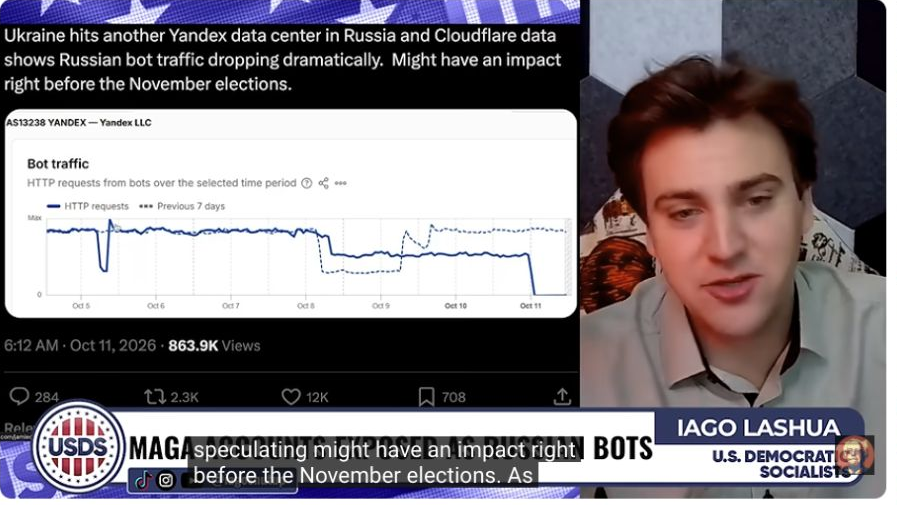
The review’s key question is not whether the presenter’s suspicion is conceivable. It is whether the material shown can distinguish that explanation from alternatives.
05 / A bot request is not a political account
Cloudflare’s bot detection documentation describes a classification of automated versus human requests. Automation includes legitimate search crawlers and scripts. A network measurement does not, by itself, identify a social account, its nationality, its political position, or the person directing it.
Observed requests≠Social accounts
Identity & behavior≠State operation
Attribution evidence
Those distinctions matter especially for a search company. A fall in crawler activity can be substantial without representing a comparable fall in political posts. A human-operated influence account can also be deceptive without being an automated bot.
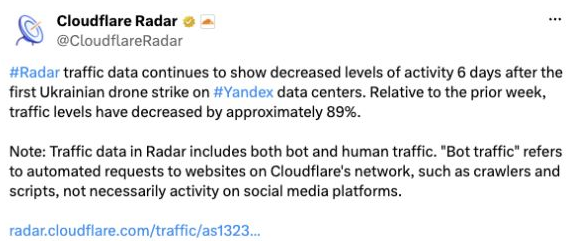
Cloudflare explicitly clarified that Radar includes human and automated traffic, and that its bot category is not necessarily social media activity. Comparing percentages without matching the time window, traffic category, and baseline risks inventing a trend the data never measured.
BBC Verify’s October 13 investigation adds an important check: researchers it consulted had not observed a change in known Russian influence networks. It also reported that Zelensky’s office framed his remarks around the online atmosphere rather than a quantified measurement of bot activity. That does not prove every covert account was unaffected. It does mean the broad claim remains unverified.
06 / Separate the claims before judging them
| Claim | What the evidence supports |
|---|---|
| Yandex traffic fell sharply. | Supported. Cloudflare reports a substantial decline in observed traffic. |
| The missing traffic was a Russian political bot army. | Not established. Network automation is not account-level attribution. |
| A different-looking comment section proves bots disappeared. | Insufficient. Selected replies lack a representative sample and a stable baseline. |
| Lower search interest proves fewer influence posts. | Different measurement. Searches, posts, accounts, and people are not interchangeable units. |
| Most of a political movement is Russian bots. | Unsupported here. No population estimate or validated account classification establishes that proportion. |
Recommendation systems, moderation, news cycles, and audience selection can all change what one person sees. These are alternative explanations to test, not findings about what happened in this instance. Screenshots document a moment; they do not automatically document a population.
07 / What stronger evidence looks like
We do not need to stretch a traffic graph to show that Russian influence operations exist. On July 9, 2024, the U.S. Department of Justice announced the seizure of two domains and searches relating to 968 social media accounts used in a covert influence operation.
According to the department and accompanying affidavits, the operation used AI-assisted fictitious personas, including accounts posing as U.S. residents, and involved RT personnel and Russia’s FSB. X suspended the identified accounts. These are attributed government findings and allegations supported by a stated investigative record—not a conclusion inferred from a line going down.
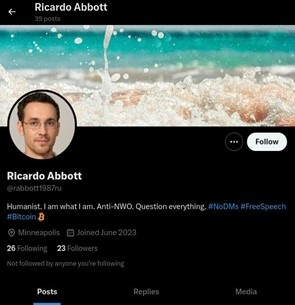
The scope still matters: The 968 accounts are the identified scope of that particular action, not an estimate of the entire influence ecosystem. They also do not measure a share of an electorate. Evidence for one operation cannot simply be transferred to another.
08 / The evidence that would close the gap
A persuasive investigation of the outage theory would need a reproducible bridge between infrastructure and behavior:
- A defined account set. Which accounts were identified as coordinated, and by what independently checkable criteria?
- Attribution. What links those accounts to the affected infrastructure or a Russian state operator?
- A consistent comparison. Measure the same accounts and activity before and after the disruption, with clearly stated dates and missing-data limits.
- Controls. Compare unaffected networks and account groups; check platform outages, enforcement, news cycles, and migration to other infrastructure.
- Independent replication. Publish enough method and aggregate evidence for other researchers to challenge the result without exposing ordinary users’ private information.
A claim about what proportion of a movement is automated would additionally need a defensible definition of that population and representative sampling. Counts of visible comments cannot stand in for political membership.
09 / What a proportionate response looks like
“Be more skeptical” puts too much of the burden on an individual reader. Platforms and institutions have access to evidence that ordinary users do not: account-control patterns, advertising relationships, enforcement records, and infrastructure connections. A serious response should improve the quality of that evidence and make public claims more auditable.
- Platforms: Publish useful explanations of attributed network removals, preserve evidence for qualified researchers, and distinguish behavior-based enforcement from disagreement with a political view.
- Newsrooms: Trace a viral clip to its first identifiable publisher before treating it as an authentic event. Clearly label fabricated material when showing it for analysis.
- Researchers: State the denominator, comparison period, attribution criteria, and missing data. Publish uncertainty alongside the headline result.
- Readers: Check whether several apparent sources all point back to the same original claim. Verify the domain of a supposed news outlet. Treat an account’s claimed location as a claim, not a credential.
These are editorial recommendations, not a guarantee that any one checklist will expose a covert operation. Avoid public accusations against individual accounts based only on posting style, political views, a flag, or a suspected accent. Investigate networks and provenance.
For this video, the next reporting step is specific
Ask for the underlying account dataset, the political-activity measurements, and the evidence connecting them to the affected Yandex infrastructure. If those become available, the outage theory can be evaluated on its merits. Until then, the established history should carry the argument about Russian influence; the outage should remain an open attribution question.
THE COMPUTER DISASTERS LESSON
Take the influence campaign seriously. Make the evidence durable.
The strongest case does not depend on one viral graph. It rests on documented networks, identified tactics, and explicit findings about political objectives. Russian efforts to aid Trump and intensify division deserve direct treatment, not a passing disclaimer. At the same time, the evidence does not establish that most MAGA participants are Russian bots.
The disaster is a system in which concealed operators can impersonate fellow citizens and news organizations, then let genuine people carry the message further. Understanding that system requires both forceful reporting on the documented operations and precision about what each new piece of evidence adds.
Related case: an agent collective and a different kind of attribution problem →Sources & review method
This is an editorial review, not an original account-forensics investigation. We reviewed the video’s transcript and selected frames, Cloudflare’s public clarification and documentation, BBC Verify’s reporting, DOJ announcements, the Senate findings, the 2020-election intelligence assessment, Microsoft’s threat reporting, and peer-reviewed research. Historical findings are attributed to their issuing bodies; criminal allegations are not presented as convictions. The impact discussion distinguishes attempts from demonstrated effects. Screenshots are limited, attributed excerpts for criticism and analysis. Cropping removes surrounding interface; no chart values or source text have been altered.
- Senate Intelligence Committee — bipartisan social-media investigation findings · October 8, 2019. Platform-data-based findings on IRA objectives, targeting, and activity.
- DOJ — IRA indictment announcement · February 16, 2018. Allegations concerning organization, identities, infrastructure, and offline activity.
- ODNI — Foreign Threats to the 2020 US Federal Elections · Released March 2021. Intelligence assessment; see key judgments and the Russia section.
- DOJ — Doppelganger domain seizures · September 4, 2024. Allegations and linked affidavit concerning counterfeit news and covert distribution.
- Microsoft Threat Analysis Center — Russian operations targeting Harris-Walz · September 17, 2024. Independent threat-research attribution and distribution observations.
- Bail and colleagues — IRA interactions and political attitudes in late 2017 · PNAS, 2020. Peer-reviewed observational research with a bounded sample and time period.
- U.S. Democratic Socialists — video under review · October 12, 2026. Evidence of the argument being made, not independent verification of its claims.
- Cloudflare Radar — traffic update and definition clarification · October 13, 2026. Primary statement from the measurement provider.
- Cloudflare — Bot score documentation · Technical definition of automation classification.
- BBC Verify — Is Zelensky right to say data centre strikes have taken down Russian bots? · October 13, 2026. Independent reporting and researcher responses.
- U.S. Department of Justice — Russian government-operated social media bot farm disruption · July 9, 2024. Primary announcement with linked affidavits.